
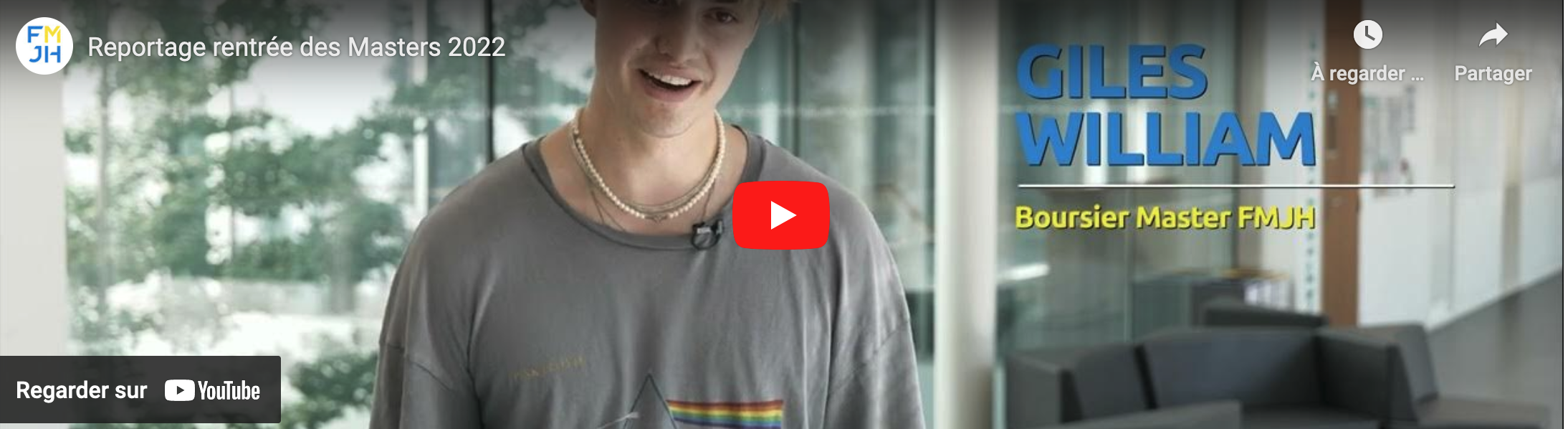
Discover our report on the back-to-school days of the Masters
Exchanges, testimonies, moments of conviviality are presented during this report.
Watch it now!
Welcome days for the "Mathematics and Applications" Master's program
Each year, the FMJH organizes welcome days for the “Mathematics and Applications” Master’s program, which is jointly accredited by the Université Paris-Saclay and the Institut Polytechnique de Paris. Organized in collaboration with the Graduate School of Mathematics at Université Paris-Saclay and the Department of Mathematics at the Institut Polytechnique de Paris, these days are a meeting place for students from all mathematical and geographical backgrounds, coming from all the institutions that make up the wide mosaic that is the Paris-Saclay Campus. The program consists of mini-courses and opening lectures on a wide variety of mathematical research topics, with themes that change from year to year. Interactive discussion sessions with doctoral students and postdocs are also offered to help young students better understand what mathematical research entails, starting from the very beginning of their master’s program.
The number of spots is limited to 150. Attendance at these sessions is required for students in the M1 Jacques Hadamard track, as well as for recipients of an FMJH scholarship (all M1 students and, for M2 students, only new arrivals). Any remaining spots will be allocated on a priority basis to incoming students at the Paris-Saclay Campus. In all cases, you must submit a registration request to participate in the event.
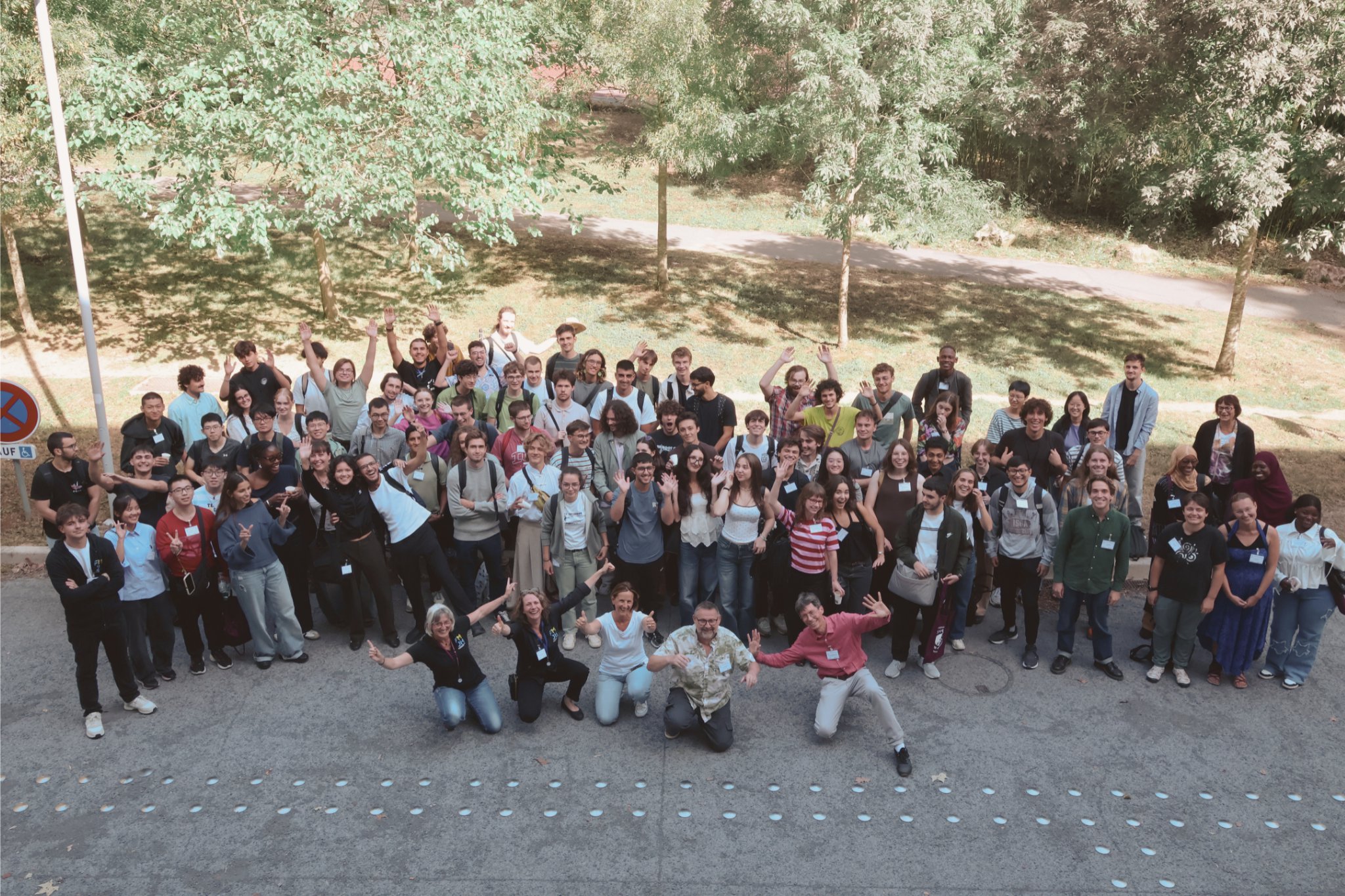
Master Starter 2026
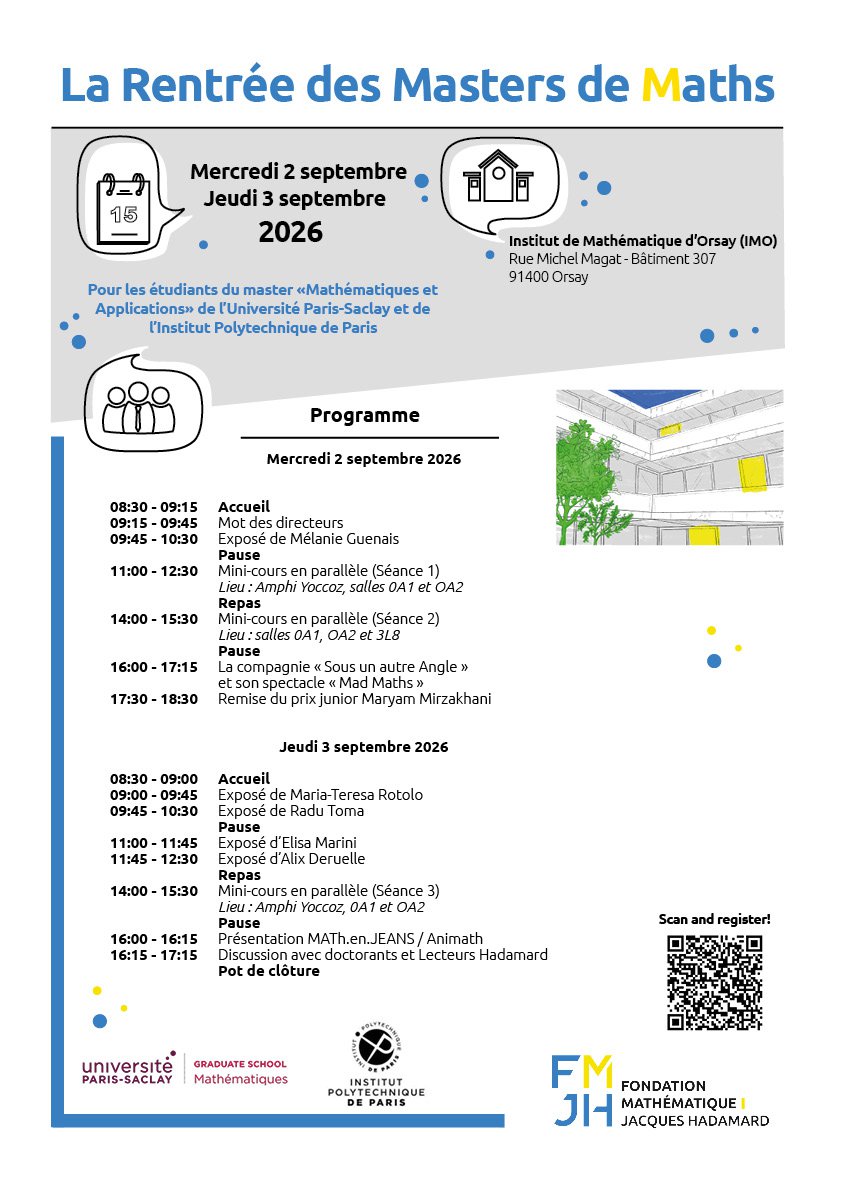
The welcome days 2026 took place on Wednesday September 2 and Thursday September 3 at the Institut de Mahématique d'Orsay.
Thank you to all the students, speakers, la Compagnie "Sous un autre Angle".
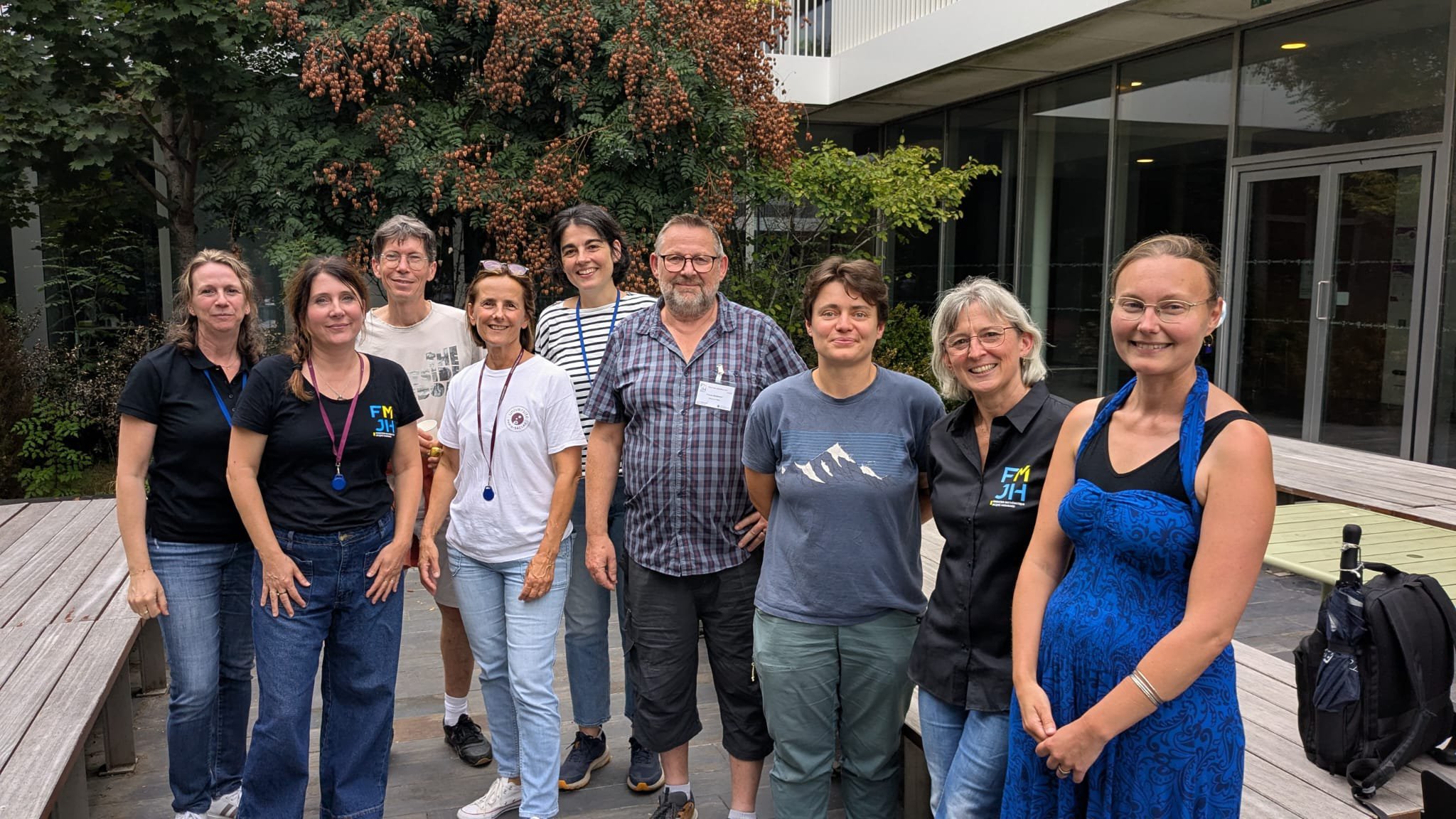
A big thank you also to the whole organising team!
Special thanks to Anne Vaugon and Blanche Buet for organising the entire scientific programme over these two days.
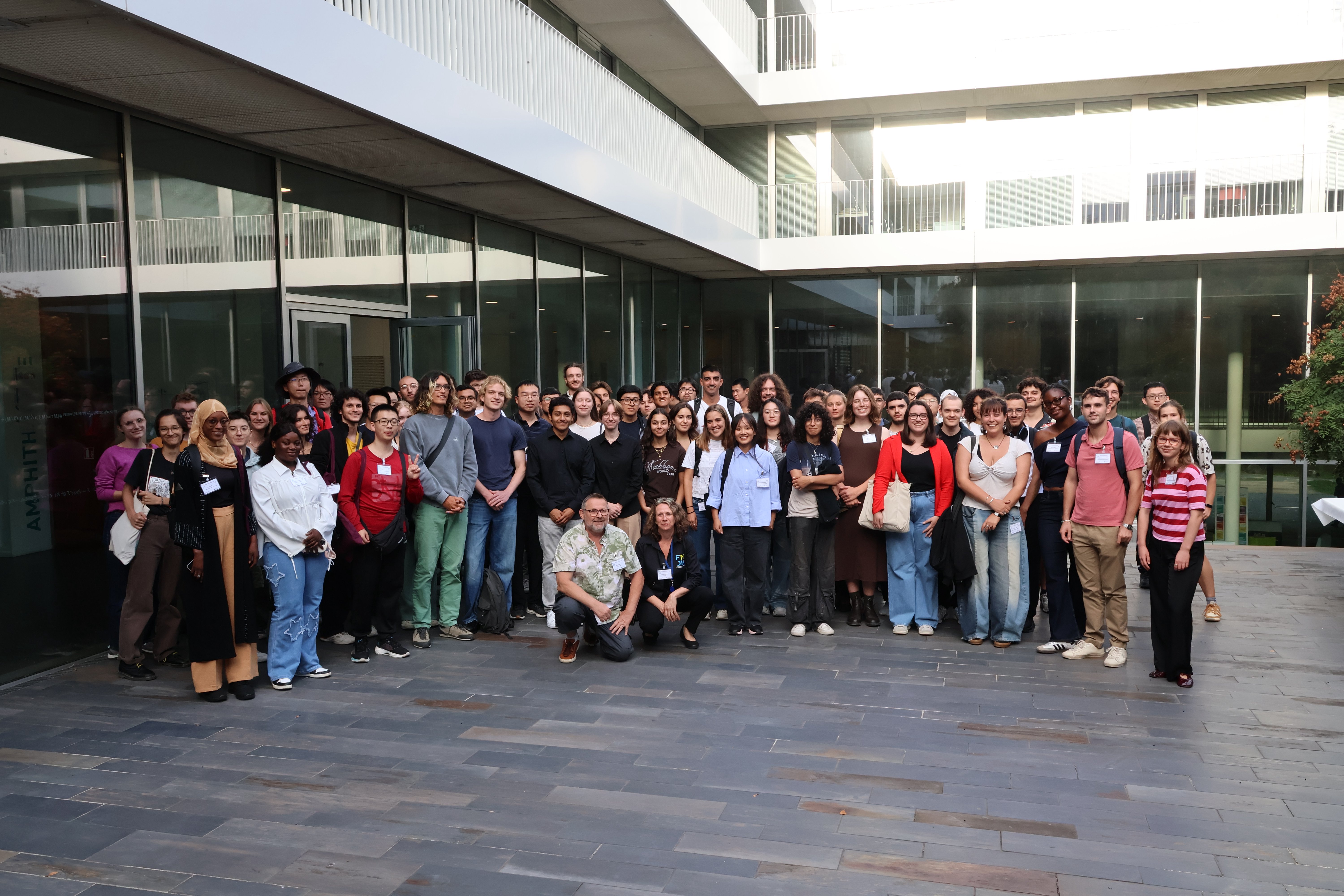
A special moment shared with all our scholarship holders.
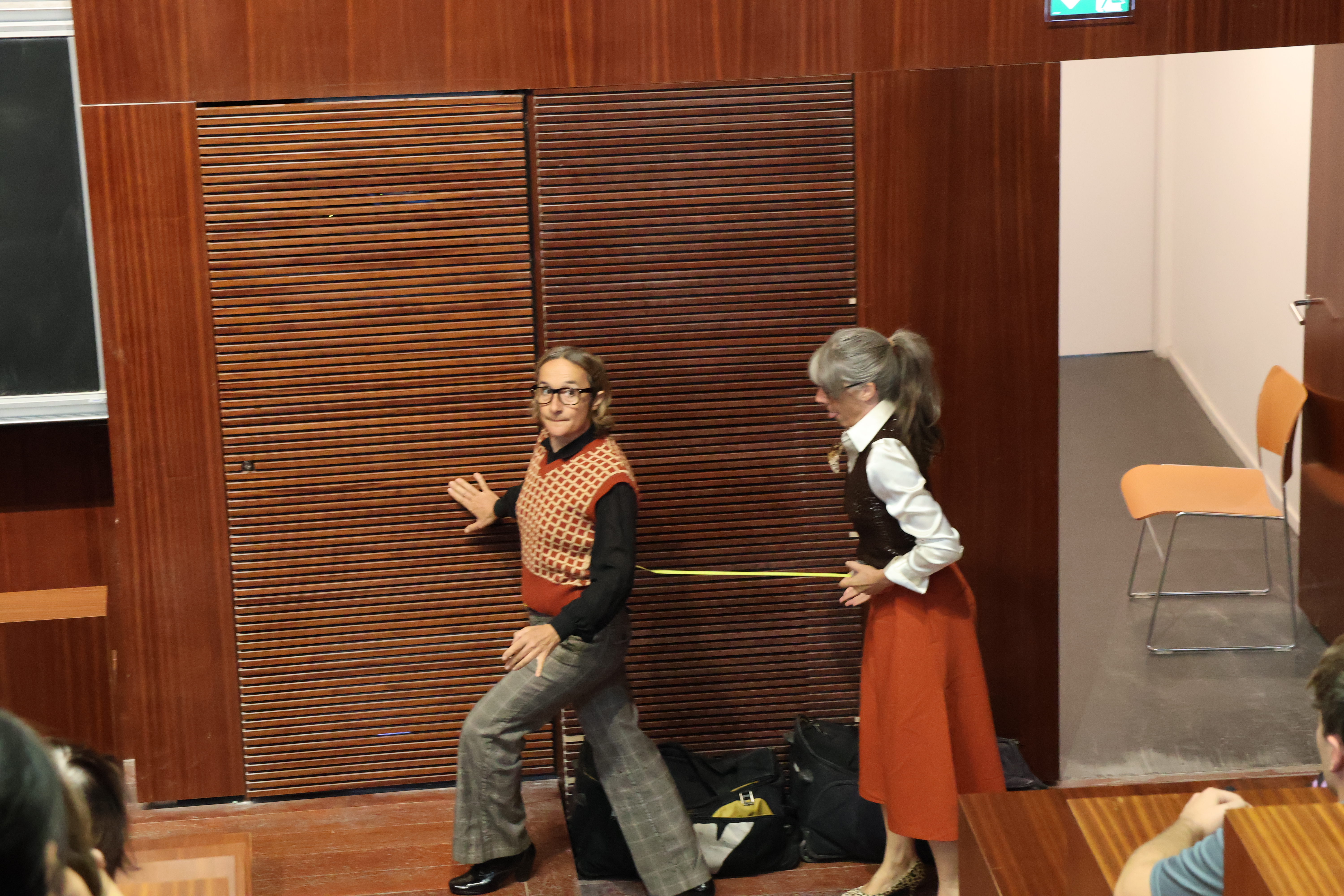
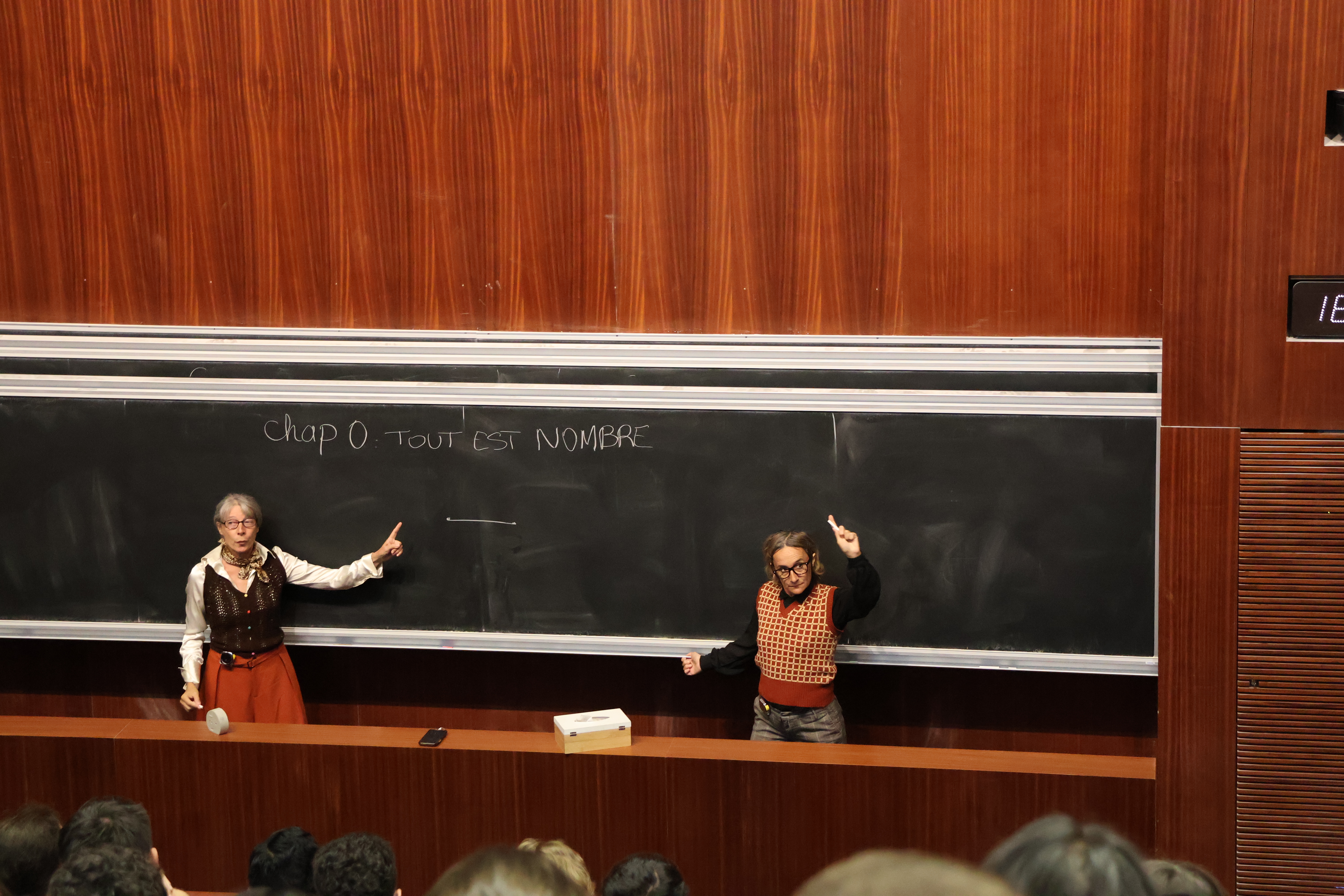
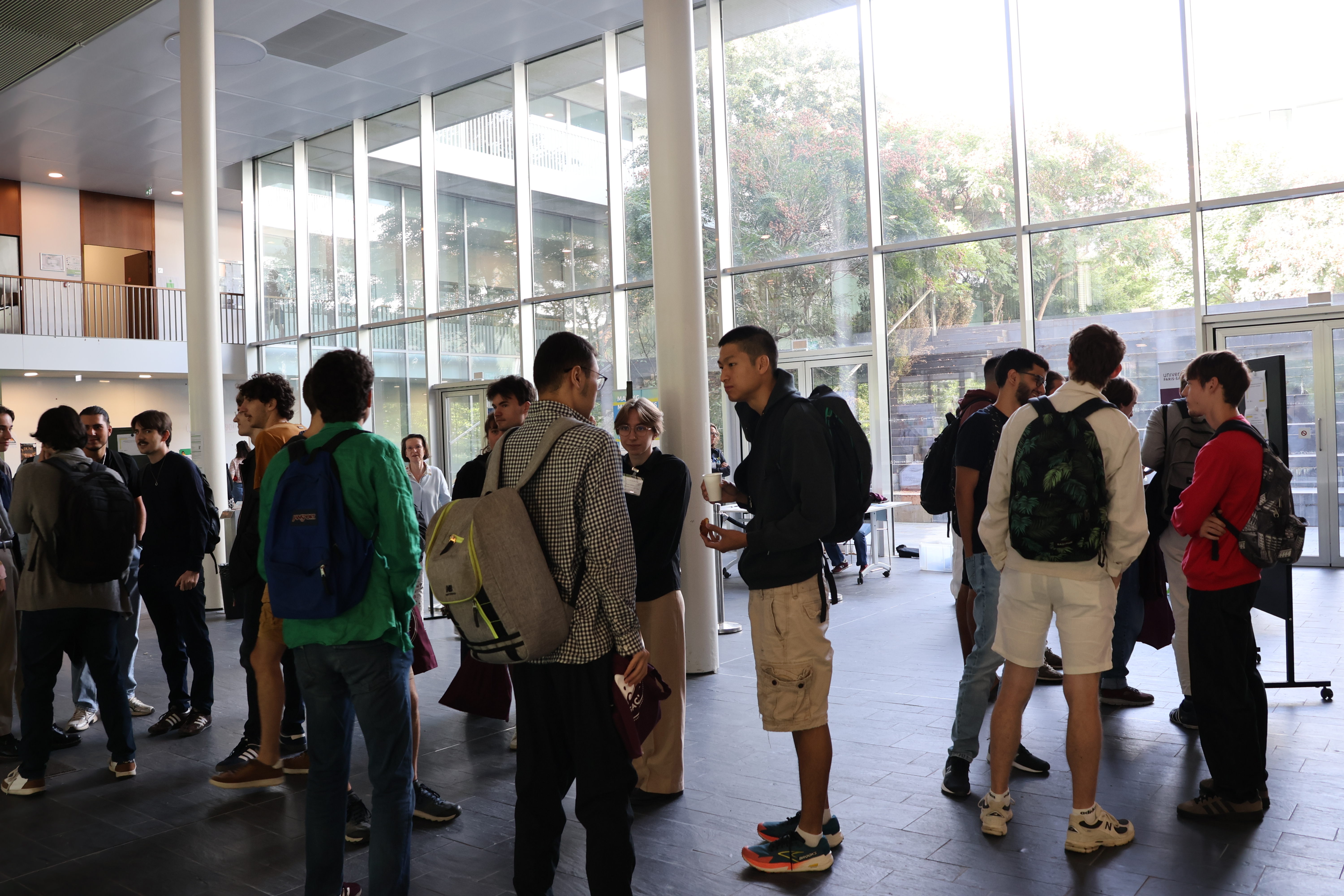
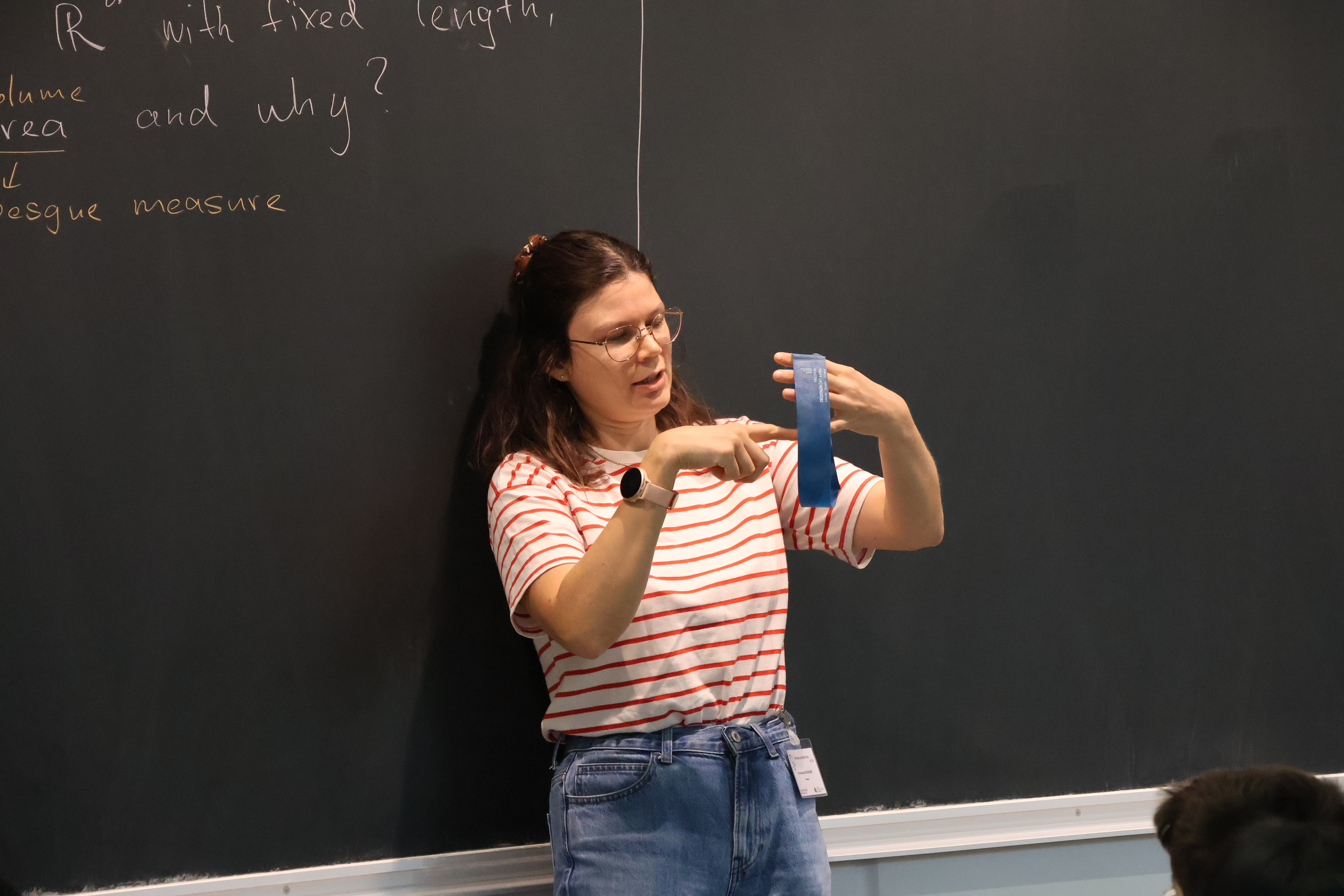
Mini-courses
- Katharina Eichinger (LMO, Université Paris-Saclay et ParMA team, Inria Saclay) - "The isoperimetric problem via optimal transport" - Room TBD
Abstract: When Dido was promised as much land as she could enclose with strips of the skin of a bull, she intuitively found a way to maximize the area of her territory. This is nowadays known as the isoperimetric problem of finding the largest area enclosed by a given length. The first rigorous mathematical treatment however seems to date back only to Euler in the 18th century. Since then, there have been many proofs and extensions of the isoperimetric problem. Here we will approach it using the Brunn-Minkowski inequality and also give an elegant proof of Brunn-Minkowski itself via optimal transport theory.
Optimal transport has been initiated by the French mathematician Gaspard Monge in 1781 as a problem of finding a way to transport mass from one location to another one while minimizing a prescribed cost. Since then, the theory has developed into a powerful mathematical framework with applications in many domains, such as physics and more recently artificial intelligence. Here, we are going to introduce the basic optimal transport theory and see how its interactions with functional inequalities and geometry on the Euclidian space can be used to solve Dido’s problem. - Amaury Freslon (LMO, Université Paris-Saclay) - "Les graphes dans le monde quantique" - Room TBD
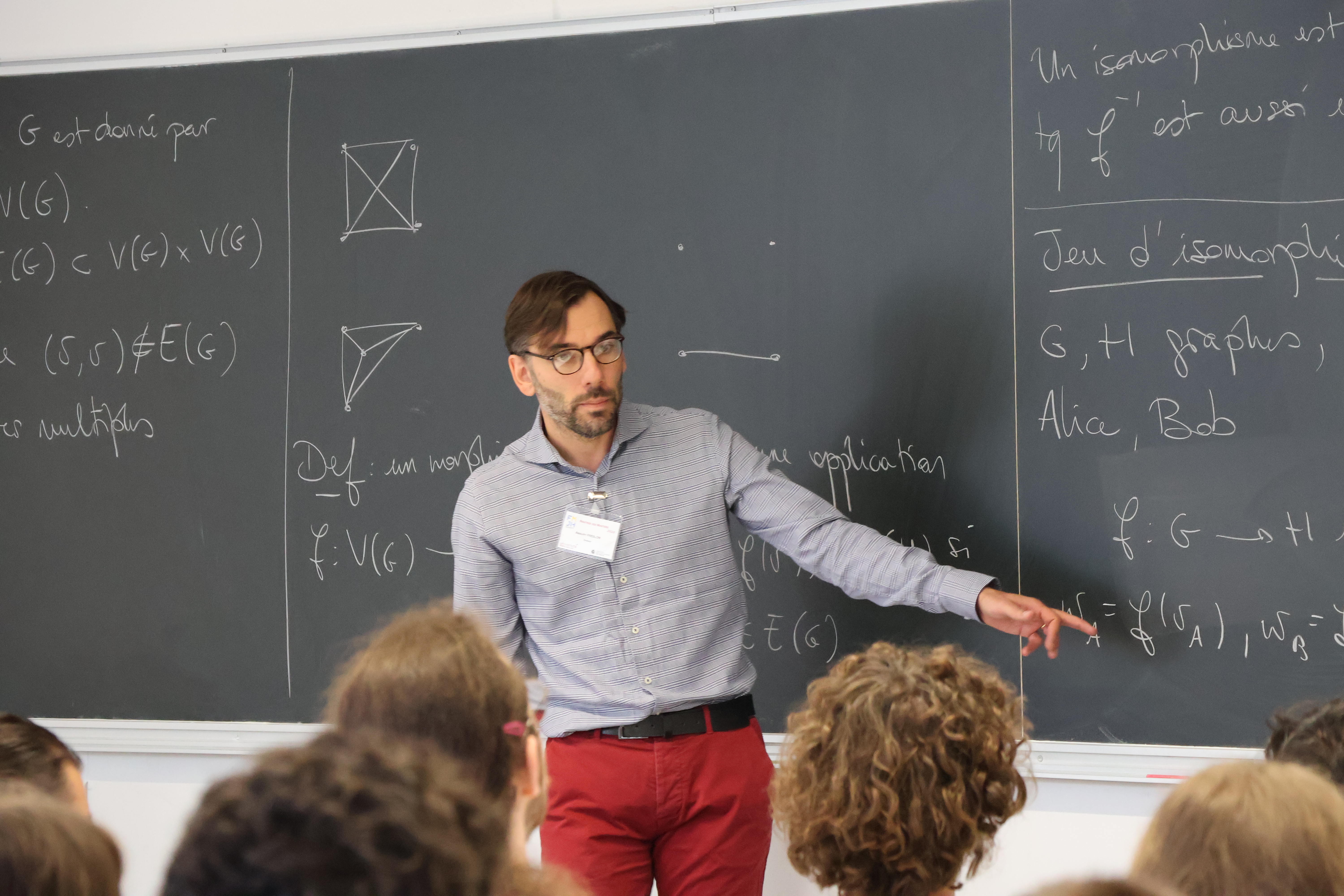
Abstract: L'isomorphisme de graphes est l'un des problèmes fondamentaux de l'informatique théorique et de la combinatoire. Ces dernières années, les idées issues de la théorie de l'information quantique ont conduit à de nouvelles notions, surprenantes, de symétrie et d'équivalence des graphes, révélant que les ressources quantiques permettent de distinguer - ou d'identifier - des graphes d'une manière impossible dans le cadre classique. Ces développements ont mis en lumière des liens profonds entre la théorie des graphes, l'analyse fonctionnelle et la géométrie non commutative.
Nous donnerons une présentation introductive de ces idées. Nous commencerons par le problème classique de l'isomorphisme de graphes et sa reformulation sous la forme d'un jeu à deux joueurs. Nous introduirons ensuite les stratégies quantiques, qui conduisent naturellement à la notion d'isomorphisme quantique. Nous conclurons enfin par une caractérisation récente de l'isomorphisme quantique en termes de comptage d'homomorphismes issus de graphes planaires, qui offre un bel exemple d'interaction entre différents champs des mathématiques. - Luca Ganassali (LMO, Université Paris-Saclay) - "Topics in random graphs" - Room TBD
Abstract: This mini-course introduces key models and fundamental results in the widely studied field of random graph theory, at the intersection of probability, combinatorics, computer science, and statistics.
We will begin with the seminal Erdős-Rényi model and study its structural properties such as degree distributions and connectivity. An beautiful result is that, when the size of the graph grows, a so-called threshold phenomena — which we will discuss — appear for most of these properties.
We will then explore how community structure can be incorporated into random graphs through the Stochastic Block Model. Building on our understanding of Erdős–Rényi graphs, we will study the statistical distinguishability of these models and address the following fundamental question: can we distinguish a random graph with community structure from a graph with no underlying communities?
Throughout the mini-course, formal proofs will be complemented by intuition and interpretation to develop both a rigorous and conceptual understanding of the subject.
Presentations
- Alix Deruelle (LMO, Université Paris-Saclay) - "Dualité convexe : de Blaschke–Santaló à la conjecture de Mahler"
Résumé : L’inégalité de Blaschke–Santaló est un résultat fondamental de géométrie convexe qui affirme que le produit des volumes d’un corps convexe symétrique et de son polaire est maximal pour les ellipsoïdes. Nous introduirons la dualité polaire, les jauges et le lien avec les normes duales, avant d’examiner quelques exemples fondamentaux, notamment le cube et le simplexe. Nous présenterons ensuite la version fonctionnelle de Blaschke–Santaló, où la dualité polaire est remplacée par la transformée de Legendre et les corps convexes par des fonctions log-concaves. Nous verrons comment l'équation de la chaleur permet de prouver une telle inégalité fonctionnelle. Enfin, nous aborderons la conjecture de Mahler, qui propose un problème inverse : les corps les plus « anguleux », en particulier le cube et le simplexe, devraient minimiser le produit volumique. L’objectif est de faire apparaître, à travers ces différents cadres, un même principe de dualité entre convexité, géométrie et analyse. - Mélanie Guenais (LMO, Université Paris-Saclay) - "Mathématiques et société, au-delà des idées reçues"
Hadamard Lecturers Prensentations
- Élisa Marini (CMAP, École Polytechnique) - "Collective self-sustained rhythmic behaviors in large systems of interacting particles"
Abstract: In the first part of the talk, we will provide an overview of collective rhythmic behaviors in stochastic systems of interacting components. Loosely speaking, such phenomena occur when a macroscopic observable of the system exhibits—typically in appropriate limiting regimes—persistent oscillations, even though its individual components have no periodic dynamics and are not subject to any external periodic forcing. Although such phenomena are ubiquitous in real-world systems—for instance, in neural networks, predator–prey dynamics, and epidemiology—they remain poorly understood from a theoretical standpoint. In the second part of the talk, we will present a toy model of interacting diffusions that displays collective oscillations. This example will illustrate some of the mechanisms that can give rise to collective rhythmic behaviors and provide a glimpse of the mathematics involved in their rigorous analysis. - Maria-Teresa Rotolo (LMJL, Université Nantes) - "Describing instabilities in dispersive PDEs: a dynamical systems approach"
- Radu Toma (LMO, Université Paris-Saclay) - "Integer points on spheres throughout the centuries"
 Photos and videos will be taken during the day and may be used as part of the FMJH's communication policy (website distribution, communication media, social networks, etc.).
If you do not wish to be photographed or filmed, please notify reception on the day of the event. You will be given a badge and a no-filming zone will be set up.
Participants are allowed to take photos for strictly personal use. Any public dissemination must respect the image rights of the persons photographed.
For any comments or further information, please contact us at: communication@fondation-hadamard.fr
Master starter archives