• Accueil

  • Programmes

  • Séminaire Itzykson

    Séminaire Itzykson

    Mis en place en 2012 à l’initiative du LabEx Mathématique Hadamard (LMH), le séminaire Itzykson est devenu l’événement phare du programme « Mathématiques et Physique Théorique » (autrefois du LMH et aujourd’hui de la FMJH), qui lui apporte son soutien. Il est actuellement coordonné par Jean-René Chazottes (CPHT), Guillaume Dubach (CMLS), Ruben Minasian (IPhT), Julio Parra-Martinez (IHES). Chacune des sessions de ce séminaire se déroule à l’IHES. 
     
    Ce colloquium dure une journée. Le matin est consacré à des exposés préparatoires visant à comprendre comment s'est mise en place la formulation mathématique du problème physique étudié ainsi qu'à donner un aperçu des enjeux et de l'histoire du sujet. L'après-midi est consacré à deux exposés, un donné par un mathématicien et l'autre par un physicien.
     
    Retrouvez les thèmes déjà abordés dans nos archives : Chaos quantique, Cartes planaires et gravité quantique, Wall crossing in Hitchin integrable systems, Espaces de modules et courbes quantiques, Feynman Integrals, Physique statistique hors équilibre, Résurgence et quantification, Parafermionic observables and 2D statistical physics, Computational and information-theoretic phase transitions in large-scale inference problems. Les vidéos de certaines sessions sont visionnables sur les sites dailymotion et youtube.
     
    Parmi les thèmes que nous comptons aborder dans le futur : la correspondance AdS-CFT, Cosmologie, Trous noirs,Théories de jauge et intégrabilité, méthodes de bootstrap en Théorie des champs conforme, Information quantique...
     
    Le but de ce séminaire est de jeter les bases d'une véritable communauté scientifique autour des mathématiques et de la physique fondamentale dans la région de Saclay/Orsay/Bures, en particulier de faire partager aux mathématiciens les enjeux de la physique contemporaine. Le public visé est composé de mathématicien-nes et physicien-nes, incluant les étudiant-es en master ou doctorat ou en séjour postdoctoral.
     
    Pour toute information pratique, contacter contact@fondation-hadamard.fr.


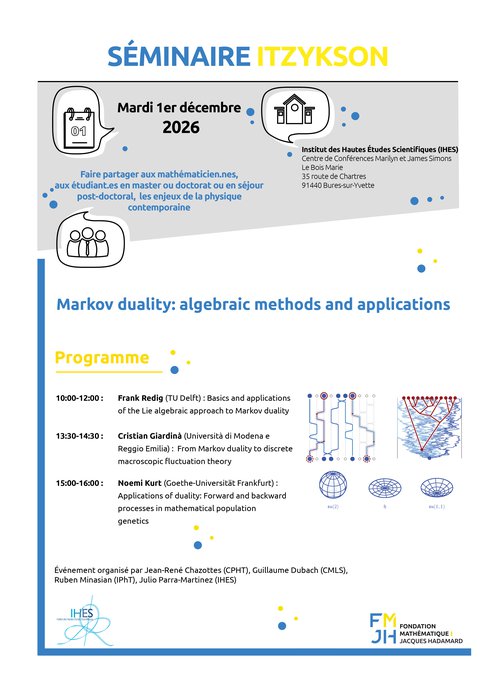
    14ème séminaire ITZYKSON

    Markov duality: algebraic methods and applications 


    Mardi 1er décembre 2026

    À l'Intitut des Hautes Études Scientifique (IHES)

    Bures sur Yvette


    Événement organisé par Jean-René Chazottes (CPHT), Guillaume Dubach (CMLS), Ruben Minasian (IPhT), Julio Parra-Martinez (IHES)

    Information et inscription

    Intervenants

    Cristian Giardinà - Università di Modena e Reggio Emilia

    From Markov Duality to Discrete Macroscopic Fluctuation Theory

    Building on the Lie-algebraic approach to duality, I will revisit the harmonic process and show that it arises as the Markov process associated with the integrable XXX_s Hamiltonian with non-compact spins. Its large-spin limit yields a lattice formulation of macroscopic fluctuation theory whose large-deviation Hamiltonian is the classical Ishimori chain. Exploiting this integrable structure, we solve the current large-deviation problem on the infinite line with step initial data (joint work with K. Mallick, H. Suda, and T. Sasamoto).

    Noemi Kurt - Goethe-Universität Frankfurt

    Applications of duality: Forward and backward processes in mathematical population genetics

    In this talk we will put the main focus on applications of the concept of duality to quite concrete stochastic models. In particular, we will shift focus from the abstract duality framework on the level of generators to consider stochastic processes in a pathwise set up. We will discuss how dual processes may often be interpreted in a strong pathwise sense as forward- and backward pictures of the same underlying stochastic models. This is particularly evident in many classical models of population genetics, such as the Wright-Fisher model, where one process describes the forward evolution of an allele frequency, and the dual process its genealogy. Thanks to this connection, duality may be applied to easily calculate quantities of interest such as fixation probabilities, as we will demonstrate.

    We will discuss several such applications in classical population genetics and in population models with dormancy, as well as in interacting particle systems, and discuss connections between strong pathwise dualities and generator dualities.

    Frank Redig - TU Delft

    Basics and applications of the Lie algebraic approach to Markov duality

    Duality is a powerful tool in the study of large-scale stochastic systems (interacting particle systems). These interacting particle systems are used to model phenomena in non-equilibrium statistical physics, as well as in mathematical population genetics. Duality allows to relate complicated interacting systems to simpler systems, e.g. systems with only a few particles, or systems where non-equilibrium driving has been replaced by absorbing boundaries.

    In the last decade, a lot of work has been done to relate duality of Markov processes to symmetries of the underlying Markov generator, and from there one is naturally lead towards simple objects in Lie representation theory such as the Casimir, coproduct, tensor products, which become tools to constructively find processes with useful dualities. For symmetric processes (detailed balance setting) these Lie algebras are classical ones (such as SU(2), SU(1,1), SU(n), SU(n,n)), whereas for the corresponding asymmetric processes, their quantum deformations are used.

    In this seminar, starting with simple examples, we show how the Lie-algebraic approach allows to unify several processes, and provides a systematic method to produce processes which have some degree of exact solvability. We start with the classical processes such as independent random walkers and the symmetric inclusion process. We will also discuss recent developments in the representation of non-equilibrium states as mixtures of product measures, and how this can be used to study fluctuations of the density profile for such systems.


    Archive Séminaires Itzykson

      Itzykson 2025

      publié le septembre 17, 2025
      Bootstrap conforme et géométrie spectrale

      Itzykson 2024

      publié le octobre 14, 2024
      Séminaire Itzykson 2024 Le 12ème séminaire Itzykson de la FMJH organisé par Sylvain Ribault (IPhT Saclay) et Pierre Vanhove (IPhT Saclay), s'est déroulé le 27 novembre 2024 à l'IHES. Il portait sur des progrès récents spectaculaires sur les relations entre …

      Itzykson 2023

      publié le décembre 6, 2023
      Séminaire Itzykson 2023 Le 11ème séminaire Itzykson de la FMJH, organisé par Maxim Kontsevich (IHES), Sylvain Ribault (IPhT Saclay) et Pierre Vanhove (IPhT Saclay), s'est déroulé le lundi 20 novembre 2023 à l'IHES. Il portait sur le : Dénombrement de …

      Itzykson 2022

      publié le septembre 22, 2023
      ​ Le 10ème Séminaire Itzykson Portant sur le thème "Valeurs zêtas multiples et fonctions modulaires de graphes en théorie des cordes", le 10ème séminaire a eu lieu à l'IHES le jeudi 17 novembre 2022. **************** Programme 10h - 12h : …

      Itzykson 2014

      publié le septembre 13, 2022
      2014 : Espaces de modules et courbes quantiques

      Itzykson 2012

      publié le septembre 13, 2022
      2012 : Chaos quantique

      Itzykson 2013

      publié le septembre 13, 2022
      2013 : Wall crossing in Hitchin integrable systems vidéo 2013 : Cartes planaires et gravité quantique video1 video2

      Itzykson 2016

      publié le septembre 13, 2022
      2016 : Physique statistique hors équilibre VIDÉO Le 6ème Séminaire Itzykson - maths physique - sur le thème "Physique statistique hors équilibre" se tiendra à l'IHÉS le mercredi 12 octobre 2016. Abstracts : Thierry Bodineau (Ecole Polytechnique) "Nonequilibrium statistical mechanics …

      Itzykson 2017

      publié le septembre 13, 2022
      2017 : Résurgence et quantification VIDEO Le 7ème Séminaire Itzykson, portant sur le thème "Résurgence et quantification" se tiendra à l'IHÉS le jeudi 20 avril 2017. Abstracts Marcos Mariño (Genève): Quantum theory and non-perturbative effects Abstract: Divergent series are ubiquitous …

      Itzykson 2018

      publié le septembre 13, 2022
      2018 : Observables parafermioniques et physique statistique 2D VIDEO Le 8ème Séminaire Itzykson, portant sur le thème "Parafermionic observables and 2D statistical physics" s'est tenu à l'IHÉS le Lundi 22 janvier 2018. Programme ************* 10h-12h Hugo Duminil-Copin (IHES) Introduction to …