
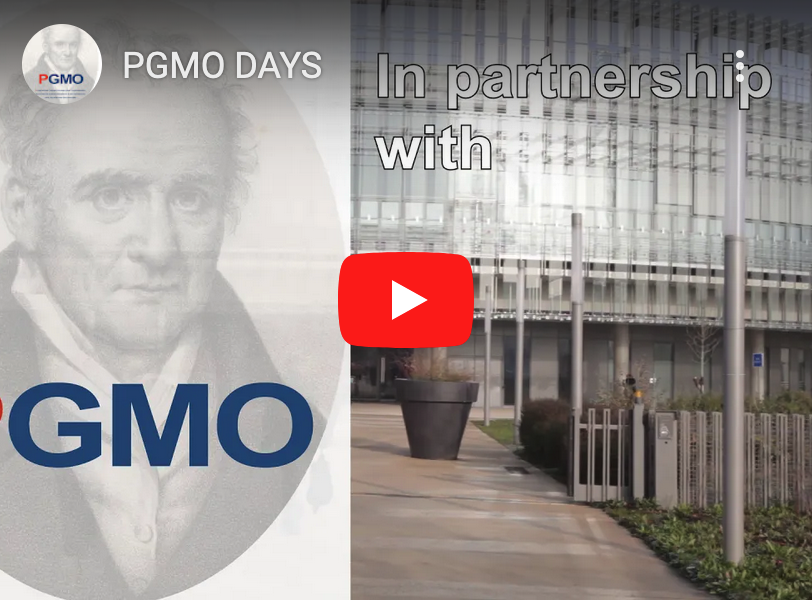
PGMODAYS 2026
Mardi 17 novembre & Mercredi 18 novembre
EDF Lab Paris-Saclay, Palaiseau, France
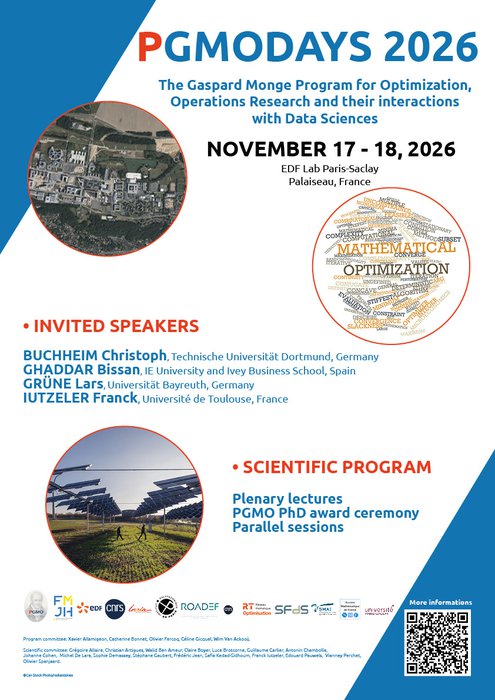
Invited Speakers
-
BUCHHEIM Christoph (Technische Universität Dortmund, Germany)
-
GHADDAR Bissan (IE University and Ivey Business School, Spain)
-
GRÜNE Lars (Universität Bayreuth, Germany)
-
IUTZELER Franck (Université de Toulouse, France)
Nos intervenants
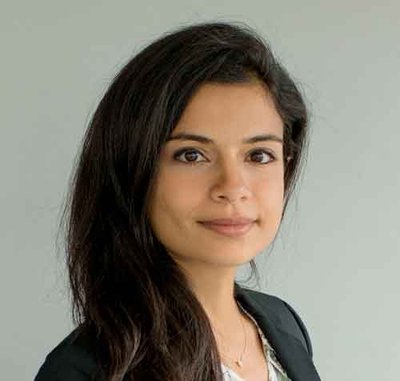
Bissan Ghaddar
IE University, Ivey Business School, Spain
Sparse Relaxations and Learned Structure for Large-Scale Polynomial Optimization
Polynomial optimization problems (POPs) arise in numerous domains such as energy systems and water networks, yet their nonconvexity poses major computational challenges. This talk focuses on exploiting sparsity structures to enable scalable global optimization of large-scale POPs. We develop formulations that leverage correlative sparsity to construct structured semidefinite and second-order cone relaxations of significantly reduced dimensionality.
We further explore machine learning models that learn variable dependencies in order to guide sparsity-pattern selection. By exploiting chordal extensions of the sparsity graph and decomposing the semidefinite matrices, the resulting sparse relaxations achieve tight bounds at tractable computational cost. Computational results on optimal power flow instances demonstrate the effectiveness of the approach.
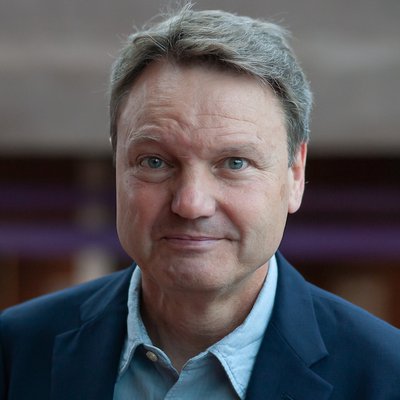
Lars Grüne
University of Bayreuth, Germany
Performance of Deterministic and Stochastic Model Predictive Control
Model Predictive Control (MPC) is one of the most successful modern control techniques. It generates a feedback control by successively solving finite-horizon optimal control problems. A key question is whether the resulting feedback is approximately optimal in some sense. In this talk we give a positive answer to this question using dissipativity and turnpike properties.
We first describe results for deterministic MPC, then present an industrial use case, and finally give a survey on recent results for stochastic MPC schemes.


Abstracts Submissions PGMODAYS 2026
Submissions on all aspects of optimization and operations research, theoretical or applied and their interfaces with data sciences are welcome.
A typical invited session consists of one block of 3 talks of 30 minutes each. Longer invited sessions with 6 talks may also be considered if the topic justifies it.
The topics of this conference include :
- continuous optimization (convex and non-convex, non-smouth...)
- optimization of large systems (decomposition-coordination methods,...)
- combinatorial optimization, integer or mixed programming
- optimization under uncertainty (stochastic and robust optimization)
- global optimization (relaxation, approximation, semi-algebraic programing, stochastic algorithms...)
- optimal control
- PDE aspects of optimization (shape optimization, optimal transport,...)
- game theory
- interfaces of optimization and data sciences, including statistical learning
- related fields : risk management, uncertainties analysis
- specific industrial applications of optimization and operations research: energy management, transportation, telecom networks,...
The leaders of PGMO projects are especially encouraged to propose presentations on the topics of their project.
Researchers willing to organize invited sessions should inform the pgmo board for pre-approval and coordination, by writing to pgmodays-coordination@fondation-hadamard.fr. After pre-apporval, they should submit via easychair a one page file with the title of the session and the list of speakers + titles.
Speakers of invited sessions should follow the same abstract submission procedure as for ordinary submissions, mentioning in addition the title of the invited session in the online form.
Deadline of abstracts submission (both for contributed talks and invited sessions) --> September 18th, 2026
Notification of acceptance --> Second half of October, 2026
Abstracts of one page should be submitted via easychair : Closed
Please follow the guidelines and template to prepare your abstracts.